SSB Stage 1 Screening in 2026: OIR, PP&DT and What Is Really Changing
Stage I
OIR tests + PP&DT
Shortlisting
Combination of OIR and PP&DT
NDA II / CDS II 2026 SSBs
Likely Dec 2026 to Jan 2027
CSSS / OPAM
Not officially notified (6 Nov 2026)
Table of Contents
If your roll number appeared in the NDA 2 or CDS 2 2026 written result last month, you already know the feeling. First the rush, then the phone calls home, and then, a few days later, a quieter thought that sits in your stomach: what if I get screened out on Day 1?
It is a fair fear. At the Services Selection Board, everything you have worked for so far gets you through the gate, and then one morning of tests decides whether you stay for the next four days. This guide explains exactly what that morning involves, what the official documents say, and what is still only rumour. That last part matters this year, because a lot of aspirants have been told that Stage 1 has “already changed”. As of 6 November 2026, we could not find any official notice that says so.
Where Things Stand in November 2026
Here is what the official documents say right now, with dates:
- NDA & NA (II) 2026: UPSC declared the written result on 9 October 2026 (exam held on 13 September 2026). Qualified candidates go to the SSB for the 158th NDA course and the 120th INAC, both commencing 1 July 2027.
- CDS (II) 2026: UPSC declared the written result on 19 October 2026. According to the press note, 8,956 candidates qualified for the SSB interview for courses at IMA, INA, AFA and OTA starting in 2027.
- When the SSBs happen: the UPSC notification for NDA (II) 2026 (dated 20 May 2026) says the SSB interviews are likely to be held from December 2026 to January 2027, or as suitable to the Recruiting Directorate.
- Registration: the NDA result press note asks candidates to register on joinindianarmy.nic.in within two weeks of the result. Selection centres and dates are then sent to the registered e-mail ID.
If you have not registered yet, do that before you read another word of this article. If you are unsure what comes after the result, our guide on what to do after your name appears in the NDA 2 2026 result walks through it step by step.
What the Official Notification Says About Stage 1
The clearest official description of the SSB is printed in the UPSC notification itself, in the section titled “Intelligence and Personality Test”. In the NDA (II) 2026 notification it says:
- The SSB is a two-stage process. Only candidates who clear Stage I are allowed to appear for Stage II.
- Stage I comprises the Officer Intelligence Rating (OIR) tests and the Picture Perception and Description Test (PP&DT).
- Candidates are shortlisted on a combination of their performance in the OIR test and the PP&DT.
- Stage II covers the Interview, Group Testing Officer tasks, Psychology tests and the Conference, conducted over four days.
- The SSB carries 900 marks, the same as the written exam.
Read that third point again, because it changes how you should think about Day 1. The shortlist is a combination of both tests. Your OIR paper alone does not decide your fate, and neither does your PP&DT story alone. You are being looked at as one person across the whole morning.
The OIR Test: What It Is Actually Checking
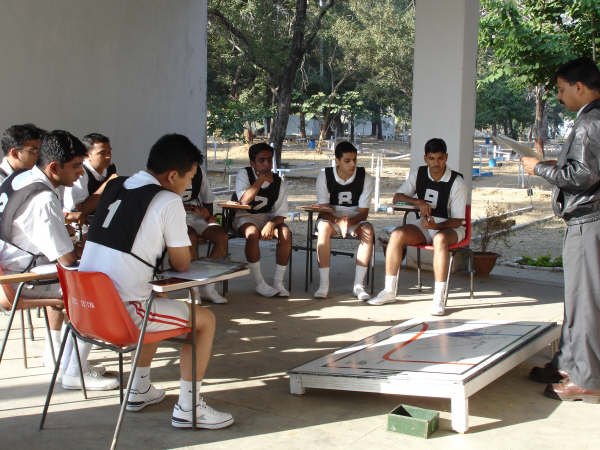
OIR stands for Officer Intelligence Rating. As the name suggests, it is a reasoning test, not a general knowledge test. It is not trying to find out how much you have memorised. It is trying to find out how quickly and cleanly your mind works under a clock.
The official documents do not publish the question format, so the following comes from how candidates and coaching institutes have consistently described the test over the years. Treat it as a guide, not an official specification:
- It is usually described as two short test booklets, one with mostly verbal reasoning and one with mostly non-verbal (figure) reasoning.
- Verbal questions typically include series, coding-decoding, analogies, odd one out, blood relations, direction sense and simple arithmetic reasoning.
- Non-verbal questions typically include figure series, mirror and water images, embedded figures, pattern completion and odd figure out.
- The difficulty of individual questions is modest. The pressure comes from the number of questions and the time.
| Question type | What trips people up | What to practise |
|---|---|---|
| Number and letter series | Spending two minutes on one stubborn question | Skip after 30 seconds, come back if time remains |
| Coding-decoding | Rushing and misreading the code | Write the pattern down once, then apply it |
| Figure series | Tracking too many changes at once | Follow one element at a time: shape, then rotation, then count |
| Mirror and water images | Mixing up left-right and top-bottom | Ten minutes of daily drill until it is automatic |
| Odd one out | Overthinking a simple difference | Trust the first clear rule you find |
The PP&DT in One Paragraph
Right after the OIR, you will be shown a hazy picture for a very short time, asked to write a story about it, and then narrate that story and discuss it with your group. We have written a full practice guide with 10 PPDT pictures for the SSB interview, so we will not repeat it here. One thing worth saying, though: in the PP&DT discussion, the board is not looking for the loudest voice in the room. It is looking for the person who listens, adds something useful, and helps the group reach a sensible common story. Calm and clear beats loud and fast, every single time.
The CSSS and OPAM Question: What Is Confirmed and What Is Not
Since April 2026, several defence news sites and coaching blogs have reported that the Indian Army plans to replace the current Stage 1 with a computer-based screening. The names you will see are CSSS (Computerised Stage-1 Selection System) and OPAM (Objective Personality Assessment Measure). Some of these reports say the change was announced through a video on the Join Indian Army YouTube channel, and that the target is the end of 2026.
Here is what we could and could not confirm as of 6 November 2026:
- Not found: any notice on joinindianarmy.nic.in, any PIB release, or any UPSC notification saying that OIR and PP&DT have been replaced. We could not verify the YouTube video ourselves.
- Still official: the UPSC NDA (II) 2026 notification, the one that governs the SSBs starting this December, still describes Stage I as OIR plus PP&DT.
- Unconfirmed details: the question counts that circulate online (around 70 cognitive questions and around 120 personality questions), the timings, and whether the change will apply to the Navy and Air Force boards as well. These come from coaching sites, not from any official document we could find.
- Reported, not official: one article from August 2026 says the new system was not yet in use and advises candidates with upcoming SSB dates to prepare for OIR and PP&DT.
Our honest advice: prepare for the Stage 1 that is officially described today, which is OIR plus PP&DT. Read your call-up letter and any instructions from your selection centre carefully, and check joinindianarmy.nic.in before you travel. If the format does change, the qualities being tested will not change: clear thinking under time pressure and an honest, steady personality. Nothing you practise for the OIR is wasted.
A Simple Four-Week OIR Practice Plan
If your SSB date falls in December or January, you have roughly four to eight weeks. That is enough time if you are consistent. Here is a plan that fits around school, college or a job:
- Week 1, find your baseline: take one full-length timed OIR practice set. Do not worry about the score. Note which question types ate your time.
- Week 2, fix the weak types: spend 30 to 40 minutes a day on your two weakest types only. Short, focused sets work better than long, tired ones.
- Week 3, speed: do timed mixed sets every day. Practise the skip-and-return habit until it feels natural.
- Week 4, simulate the morning: two or three times this week, sit an OIR set and then immediately write a PP&DT story and narrate it aloud. Stage 1 is one long morning, and your brain needs to learn to switch from puzzles to stories without a break.
Alongside this, sleep properly and eat a real breakfast. It sounds like something your mother would say, but tired candidates make silly mistakes in reasoning tests, and a reasoning test is built to catch silly mistakes. If you need help with fitness before the SSB as well, our guide on improving your running time and physical fitness is a good place to start.
What to Carry on Reporting Day
Follow the instructions in your own call-up letter first, because these can differ by selection centre and entry. From the UPSC documents, these points are clear:
- Original certificates of age and educational qualification must be submitted at the SSB, not sent to UPSC (NDA result press note, 9 October 2026).
- NDA candidates who clear Stage II must submit the originals with one photocopy each: the Matriculation certificate (for date of birth) and the 10+2 certificate (NDA II 2026 notification).
- CDS candidates have separate instructions in their press note about where originals for age, education and NCC (C) certificates go, depending on first choice of service.
Keep a folder with photocopies and passport-size photographs as well. It is a small thing, but walking in organised helps you feel organised.
Mistakes We See Before Screening
- Practising only the PP&DT because it feels more “SSB-like”, and ignoring the OIR. The shortlist uses both.
- Learning a fixed PP&DT story to fit any picture. Assessors have seen every memorised story there is.
- Chasing the CSSS rumour and buying mock tests for a format that is not yet officially notified, while neglecting the format that is.
- Treating screening as a failure verdict. Many good candidates are screened out on Day 1, and many later become officers on a second or third attempt. No official screen-out rate is published, so ignore anyone who quotes exact percentages with great confidence.
How NDDA Helps With SSB Preparation
At Noval Doon Defence Academy in Dehradun, SSB preparation sits alongside our written exam coaching. If you would like structured practice for the OIR, PP&DT, psychology tests and GTO tasks, take a look at our SSB coaching in Dehradun page or contact us to ask about the next batch. If you are still building your basics, our article on Officer Like Qualities (OLQs) explains what the board is looking for across all five days.
Frequently Asked Questions
What is Stage 1 of the SSB interview?
According to the UPSC NDA (II) 2026 notification, Stage I comprises the Officer Intelligence Rating (OIR) tests and the Picture Perception and Description Test (PP&DT). Only candidates who clear Stage I continue to Stage II.
Is the OIR test alone enough to clear screening?
No. The notification says candidates are shortlisted on a combination of OIR and PP&DT performance.
Has the OIR test been replaced by CSSS and OPAM?
As of 6 November 2026, no official notice confirming this was found. The UPSC NDA (II) 2026 notification still describes Stage I as OIR plus PP&DT. Check joinindianarmy.nic.in and your call-up letter for any update.
When will the NDA 2 2026 SSB interviews be held?
The UPSC notification says they are likely to be held from December 2026 to January 2027, or as suitable to the Recruiting Directorate.
Getting ready for your SSB?
Practise the OIR, PP&DT, psychology tests, GTO and interview with SSB preparation at Noval Doon Defence Academy, Dehradun.
Sources
All facts in this article were checked on 6 November 2026.
- UPSC, NDA & NA (II) Examination 2026 notification, dated 20 May 2026: Intelligence and Personality Test section, scheme of examination, likely SSB months.
- UPSC, NDA & NA (II) 2026 written result press note, dated 9 October 2026.
- UPSC, CDS (II) 2026 written result press note, dated 19 October 2026.
- Reports on CSSS and OPAM: secondary sources only (defence news and coaching websites, April to August 2026). Not confirmed by any official notice we could find.
Reach Us