Master Common GTO Tasks: How to Lead Your Group in SSB
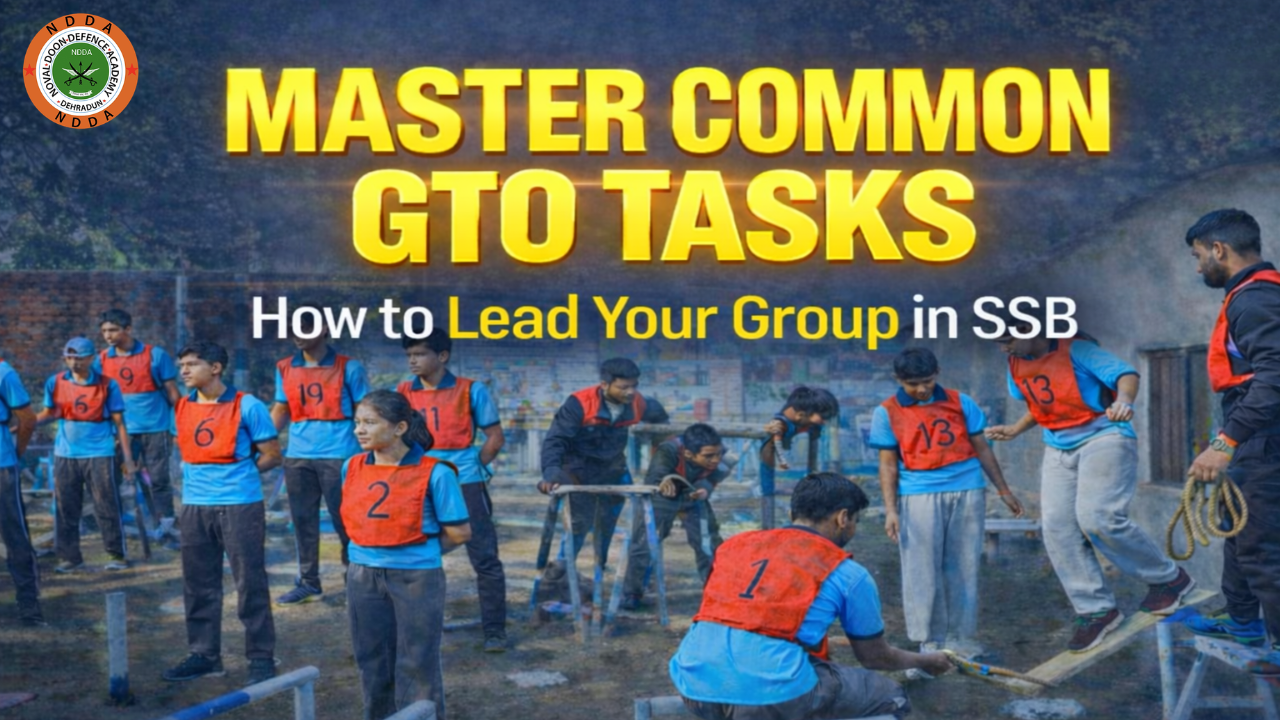
Table of Contents
Welcome to Noval Doon Defence Academy, the premier destination for NDA coaching in Dehradun. If you are aspiring to wear the uniform, you already know that the Service Selection Board (SSB) interview is the ultimate bridge between your dreams and reality. While the Psychology test probes your mind and the Interview tests your personality, the Group Testing Officer (GTO) tasks evaluate your ability to function as a productive limb of a team.
In SSB interviews, just 1 in 50 candidates clear the GTO stage, according to recent UPSC data trends from 2025. This statistic isn’t meant to discourage you; it’s meant to highlight a simple truth: many candidates are physically fit but socially ineffective. The GTO’s role is specifically designed to spot leaders in their natural habitat—the group.
Through a series of nine activities spread over Day 3 and Day 4, the GTO observes how you interact, solve problems, and influence others. This blog will provide you with actionable steps to guide your team and promise real tips derived from the experiences of successful officers.
What GTO Tasks Really Test
The GTO is not looking for a “superman” who can jump the highest or run the fastest. They are looking for an individual who possesses the Key Officer Like Qualities (OLQs).
Spot the Key Officer Qualities
The GTO tasks are a laboratory for your character. Traits like Initiative, Effective Intelligence, Cooperation, and Sense of Responsibility are non-negotiable. For example, in the Progressive Group Task (PGT), if you see a teammate struggling with a heavy load and you step in to help without being asked, you demonstrate a “Sense of Responsibility.”
“The GTO isn’t watching to see if you reach the finish line first; he is watching how you solve problems as a team,” says a veteran assessor often cited in our training modules.
Actionable Takeaways:
- Show courage early: Don’t wait for the third obstacle to give an idea.
- Listen before you speak: A leader who doesn’t listen is just a boss.
Understand Group Dynamics
Group dynamics can make or break your recommendation. Statistics from various SSB coaching surveys suggest that 70% of failures in the GTO ground are due to poor cooperation rather than a lack of physical strength.
Consider a case study of a group that split during the PGT because two “alpha” personalities couldn’t agree on where to place the plank. Because they refused to yield, the entire group timed out, and no one was recommended from that batch. To avoid this, you must:
- Build trust fast: Use names and be encouraging from the first minute.
- Share ideas equally: If your idea is rejected, don’t sulk; support the next best plan.
Break Down the Top GTO Tasks
To master the common GTO Tasks, you must understand the nuances of both indoor and outdoor activities. At Noval Doon Defence Academy, we break these down into two main categories: verbal and physical.
Group Discussion and Lecturette
The Group Discussion (GD) and Lecturette are the “Brain Tasks.” In the GD, you discuss two topics—usually one on social issues and one on current affairs.
GD Rules for Success:
- Speak early: This shows initiative.
- Stay on topic: Don’t wander into unrelated “Basic Solver Setup” or technical jargon.
- Acknowledge others: Use phrases like, “I agree with Chest No. 14, and I’d like to add…”
In the Lecturette, you have 3 minutes to speak on a chosen topic. A candidate in the 2025 batch won over the GTO by summarizing complex geopolitical points into three simple, digestible headers.
Takeaways:
- Prep 5 hot topics: Current affairs are your best friends.
- Keep talks under 2 minutes: In GD, brevity is the soul of wit.
Progressive Group Task (PGT)
The PGT is the heart of the outdoor ground. You are given helping materials—a plank (phatta), a rope, and a wooden log (balli)—to cross four obstacles. The color rule is your bible here:
- White: Both candidates and material can touch.
- Yellow: Candidates can stand, but material cannot touch.
- Red: Neither candidates nor material can touch.
Expert Tip: “Lead from the front but always look back to help the weak links.” Your job is to ensure the “Snake” or the load moves with the group.
Actionables:
- Plan the route first: Don’t just rush in; look at the GTO tree navigation tasks (the mental map of the obstacle).
- Motivate stragglers: If someone is afraid of heights, give them a hand.
Strategies to Lead Your Group
Leadership in the SSB isn’t about shouting orders. It’s about being the person the group wants to follow.
Take Charge Without Bossing
Stats show that natural leaders score 20% higher in command tasks. A natural leader doesn’t say “Do this”; they say “Let’s try this.” In a recent case, a team ace used questions like “Do you think the plank will reach that bar?” to guide his team’s ideas without appearing arrogant.
Bullet Steps to Leadership:
- Volunteer first: Be the one to carry the heavy load or the “snake.”
- Assign roles clearly: If you are in the Command Task (CT), pick subordinates who complement your weaknesses.
Handle Conflicts Smartly
Arguments are common in the Half Group Task (HGT) because the smaller group size makes every opinion louder. If a conflict arises, fix it through compromise. Focus on the goal, not the ego. As many SSB trainers suggest, a “Calm voice wins trust” when the group is under pressure.
Tips for Conflict:
- Stay positive: Use humor to de-escalate tension.
- Focus on the goal: Remind the group of the time limit.
Integrating Technical Precision
While the SSB is a physical and mental test, preparing for it requires a structured approach, much like a GTO solver setup steps. Just as a professional poker player might install common GTO solvers to analyze their game, an NDA aspirant must install a “leadership solver” in their mind.
You need to build poker ranges GTO style—meaning, you need a range of responses for every situation. Whether it is a simple GTO solver workflow for solving a PGT obstacle or using GTO+ first time setup logic to organize your thoughts during a GPE, structure is key.
You must build poker ranges GTO (Group Task Optimization) by practicing:
- Common preflop GTO ranges: Your opening remarks in a GD.
- Edit GTO ranges solver: Adjusting your plan when the GTO adds a “Red” rule constraint.
Standard GTO flop ranges: Your initial reaction to a Command Task.
Prep Tips and Common Mistakes
Build Skills Before SSB
Don’t wait for the call letter to start practicing. Daily drills such as mock GDs boost confidence by 40%, according to coaching statistics from our academy.
Your Action Plan:
- Practice obstacles weekly: Visit a local park or a dedicated training ground.
- Record lectures for feedback: Watch your body language and tone.
- GTO sim review process: After every practice session, sit down and analyze what went wrong. Did you lock nodes in GTO solver (get stuck on one idea) or were you flexible?
Dodge Big Errors
The biggest pitfalls are yelling at teammates or sitting quietly in a corner. A case study of an “over-leader” showed he lost the group’s respect in the Snake Race because he prioritized his own speed over the group’s “snake.”
Fixes:
- Balance talk and action: If you have an idea, show it with the helping material.
- Watch body language: Keep your hands out of your pockets and maintain an upright, confident posture.
Advanced Prep: The Technical Edge
For those looking for a deep dive, think of your preparation as advanced PioSolver scripts. You should be able to analyze GTO trees basics of any physical obstacle.
- Multiway GTO tasks: How to handle multiple people giving ideas at once.
- Custom GTO spot builds: Preparing for unique obstacles like the “Tiger Leap.”
- Deep stack GTO builds: Maintaining stamina through the 9th task of the day.
Even if you are looking for free GTO solver options (like YouTube videos or blog posts), nothing beats the hands-on experience of a simulated GTO ground.
Conclusion
Mastering common GTO Tasks is about balancing your individual brilliance with the group’s collective effort. From the Group Planning Exercise (GPE) to the Final Group Task (FGT), every moment is an opportunity to prove you belong in the Indian Armed Forces.
Recap of Top Tips:
- Master the colour rules and the distance rule.
- In GD and Lecturette, prioritize clarity over volume.
- In outdoor tasks, be the “engine” of the group, not just the “driver.”
Final Stat: Prepared candidates who have undergone simulated GTO training clear the stage 3x more often than those who go in raw.
FOR MORE BLOGS :
1. Basic Officer Like Qualities (OLQs) Required to Clear SSB Interview
2. Best CDS Defence Academy in Dehradun: Best CDS Coaching Institute with SSB & Hostel
3. How to Balance Board Exams and NDA Preparation: Proven Tips for Success
Frequently Asked Questions about GTO
1. What are the tasks in GTO?
The GTO testing consists of 9 distinct tasks designed to test your social and mental adaptability. These include:
- Two Group Discussions (GD): Verbal brainstorming on social and current issues.
- Group Planning Exercise (GPE): Solving a map-based situational crisis.
- Progressive Group Task (PGT): The primary outdoor obstacle course using helping materials.
- Snake Race (Group Obstacle Race): A high-energy competitive race against other groups.
- Half Group Task (HGT): A smaller-scale version of PGT to observe individual impact.
- Lecturette: A short individual speech to test command over language and thoughts.
- Individual Obstacles (IO): 10 physical hurdles to test your personal stamina and “GTO solver setup steps” for movement.
- Command Task (CT): A leadership test where you lead two subordinates through an obstacle.
- Final Group Task (FGT): One last team hurdle to finish the testing.
2.How many tasks are there in GTO?
There are exactly 9 tasks conducted over a span of two days (usually Day 3 and Day 4 of the SSB interview). These tasks move from indoor theoretical discussions to outdoor physical applications.
3.What are the GTO tasks in NDA?
The tasks for NDA (National Defence Academy) aspirants are identical to those for other entries like CDS or AFCAT. The GTO looks for the same 14 Officer Like Qualities (OLQs), though the expectations for “Effective Intelligence” are tailored to the candidate’s age and educational background. The core remains the common GTO Tasks like PGT, HGT, and the Command Task.
4.What is the task of a Group Testing Officer?
The Group Testing Officer is a trained assessor whose job is to observe candidates in a group setting. Unlike the Psychologist, the GTO sees you in action. Their “task” is to filter out individuals who can lead, follow, and cooperate simultaneously. They look for how you lock nodes in GTO solver (mental problem-solving) when faced with physical “Red” rules on the ground.
Reach Us