Indian Army Ranks and Insignia – Complete Guide
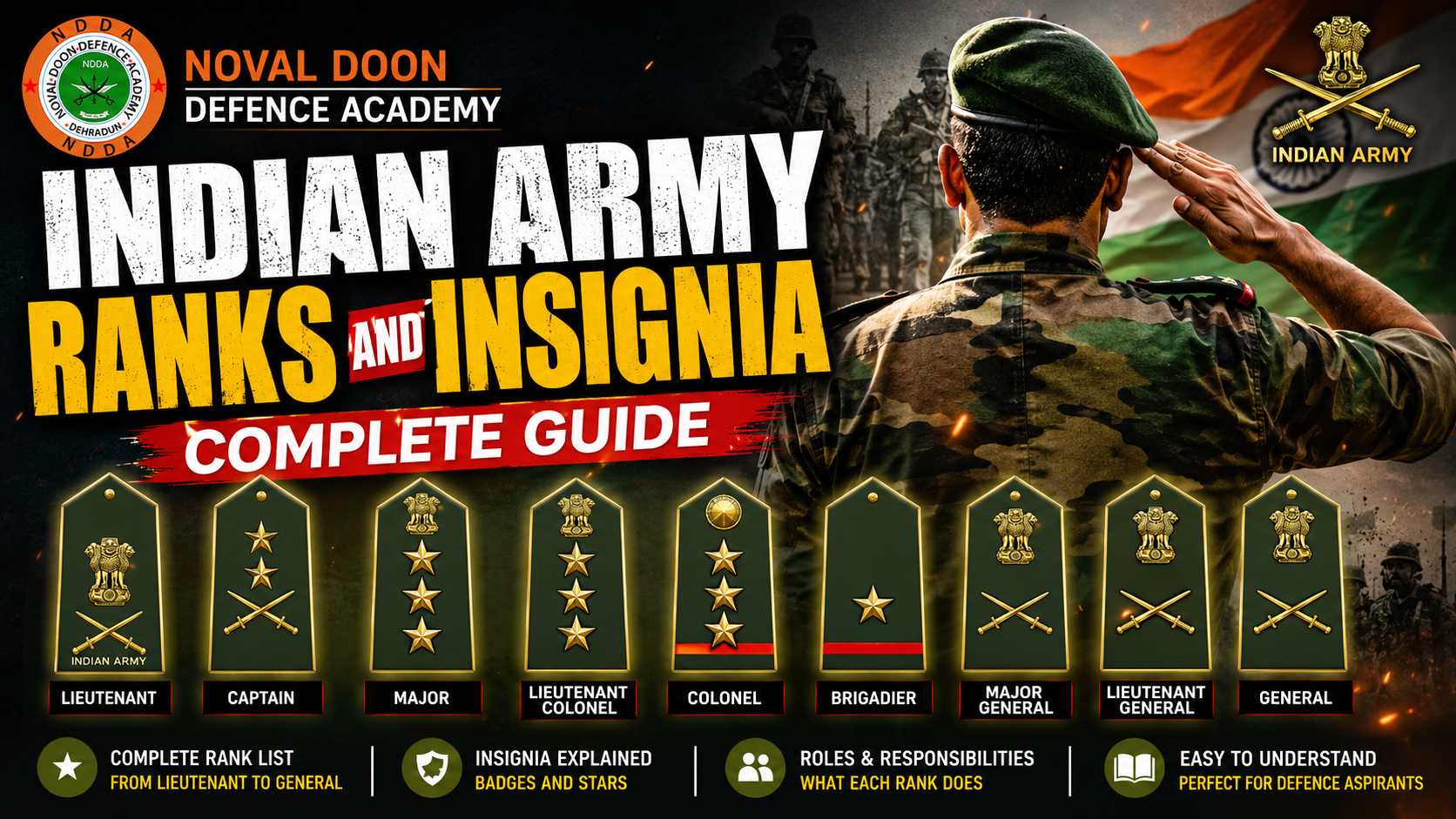
Table of Contents
Indian Army Ranks and Insignia — these are the symbols that tell you who commands whom. The moment you look at a soldier’s shoulder or collar, those stars, stripes, and emblems speak a language of their own. If you have ever wondered what each badge means, this guide will explain everything in simple language.
The Indian Army is made up of three main categories of personnel: Commissioned Officers, Junior Commissioned Officers (JCOs), and Other Ranks (Non-Commissioned Officers and Soldiers). Together, these form one of the most powerful land armies in the world — currently ranked among the top four militaries globally.
In this complete guide, we cover every single rank in Indian Army from lowest to highest, with insignia details, gorget patches, retirement age, salary, and a comparison with Indian Navy and Air Force ranks.
Commissioned Officers – Indian Army Officer Rank Structure
Commissioned Officers are the leadership backbone of the Indian Army. They are responsible for commanding troops, planning operations, and representing the military in both national and international capacities. The journey begins with rigorous training at prestigious institutions like the Indian Military Academy (IMA), Dehradun, the National Defence Academy (NDA), Khadakwasla, or the Officers Training Academy (OTA), Chennai. The lowest rank is Lieutenant and the highest active rank is General. The Field Marshal is an honorary five-star rank above General, awarded only in extraordinary circumstances.
★★★★★ - Field Marshal
Highest rank in the Indian Army · Awarded only in exceptional circumstances
The Field Marshal is the highest rank in the Indian Army and the pinnacle of the entire Indian Army rank structure. It is an honorary five-star rank and is not a regular appointment — meaning a Field Marshal does not hold active command or day-to-day administrative responsibilities. It is conferred by the President of India on the advice of the Prime Minister and Union Cabinet, usually during wartime or as a supreme recognition of extraordinary service to the nation.
In India’s post-independence history, only two officers have ever been awarded the rank of Field Marshal:
- Field Marshal K.M. Cariappa (1986) — the first Commander-in-Chief of the Indian Army after independence.
- Field Marshal Sam Manekshaw (1973) — the architect of India’s decisive victory in the 1971 Indo-Pakistan War that led to the creation of Bangladesh.
- Crossed Swords: Placed at the centre, symbolising supreme military authority and combat command.
- Five-Pointed Star: Positioned above the crossed swords, representing the five-star status and supreme seniority.
- Ashoka Lion Capital: The national emblem placed at the top, signifying that the holder represents the authority of the Indian state itself.
- Lotus Wreath: The entire insignia is framed within a golden lotus wreath, distinguishing it from all other ranks.
★★★★ - General
Highest active rank · Chief of Army Staff (COAS)
The General is the highest active rank in the Indian Army. It is a four-star rank, senior to Lieutenant General and below only the honorary Field Marshal. The officer holding the rank of General typically serves as the Chief of Army Staff (COAS) — the professional head of the Indian Army — or as the Chief of Defence Staff (CDS), who oversees all three armed forces. A General is responsible for the overall operational direction, strategic planning, and readiness of the entire Army.
As of 2025, the Chief of Army Staff is General Upendra Dwivedi, who assumed office on 30 June 2024 as the 30th COAS of independent India.
- For COAS: Crossed sword and baton, with a five-pointed star and the Ashoka Emblem above.
- For CDS: A gold-wreathed tri-service emblem combining the Naval anchor, Army crossed swords, and Air Force eagle — with the Ashoka Emblem on top.
★★★ - Lieutenant General
Commands Army Corps and large formations
The Lieutenant General is a three-star officer rank, positioned above Major General and below General. It is one of the most senior active ranks in the Army and holds enormous command responsibility. A Lieutenant General typically commands an Army Corps — a large operational formation consisting of multiple divisions and supporting elements, often numbering 50,000–1,00,000 personnel. They also serve as Army Commanders of one of India’s seven operational commands, or hold key positions at Army Headquarters in New Delhi.
The Lieutenant General rank insignia features crossed sword and baton with the Ashoka Emblem placed above — a combination that clearly signals senior general officer status at a glance.
- Crossed Sword and Baton: The combined symbol of combat leadership and command authority.
- Ashoka Emblem: Placed above the sword and baton, representing national authority.
★★ - Major General
Commands a Division — approximately 15,000 soldiers
The Major General is a two-star rank in the Indian Army, sitting above Brigadier and below Lieutenant General. It is the third-highest active rank in the Army. A Major General typically commands a Division — a large combined-arms formation that includes infantry, armour, artillery, and support units. The Indian Army has 40 divisions organised across 14 corps.
Officers at this rank also serve as General Officer Commanding (GOC) of sub-areas, or hold critical staff positions at Army Headquarters such as Additional Director General in various directorates. The Major General rank insignia features crossed sword and baton with a single five-pointed star above — distinctly different from the Ashoka Emblem combination seen in higher ranks.
- Crossed Sword and Baton: The hallmark symbol of general officer rank in the Indian Army.
- One Five-Pointed Star: Placed above the crossed sword and baton, distinguishing this rank from Lieutenant General.
🔰★ Brigadier
1-Star Commands a Brigade — approximately 3,000 soldiers
The Brigadier is a one-star rank in the Indian Army, positioned above Colonel and below Major General. A Brigadier typically commands a Brigade — a combined formation of multiple battalions along with artillery, engineers, and logistics support. At this level, the Brigadier is responsible for the operational effectiveness of a complete tactical force.
Brigadiers also hold key staff appointments such as Brigadier General Staff (BGS) and Brigadier Administration at Corps Headquarters. Some Brigadiers serve as military attachés and senior advisors in Indian embassies in select countries. At Army Headquarters, they hold roles as Deputy Director General in various branches.
The Brigadier rank badge features the Ashoka National Emblem at the top with three five-pointed gold stars arranged in a triangular formation below it — making it one of the most visually distinct insignia in the Indian Army officer rank structure.
- National Emblem (Ashoka Lion Capital): Placed at the top, indicating senior commissioned officer status.
- Three Five-Pointed Stars: Arranged in a triangle below the emblem — the maximum number of stars worn in the pip-based format.
Commissioned Officer
🔰★★ Colonel
Regimental command · Senior staff appointments
The Colonel is a senior officer rank in the Indian Army, sitting above Lieutenant Colonel and below Brigadier. It is equivalent to a Captain in the Indian Navy and a Group Captain in the Indian Air Force. Colonels often serve as commanding officers of a regiment, hold key staff positions at higher formations, or serve in important training and policy roles at Army Headquarters.
The Colonel insignia meaning is clear from its shoulder badge — two gold pips along with the National Emblem positioned above them. This combination places the Colonel firmly in the “Ashoka + Star” group of senior officers, distinguishing them from the Junior Officer (pip-only) group of Major and below.
- National Emblem (Ashoka Lion Capital): Above the stars, confirming senior commissioned rank.
- Two Five-Pointed Stars: Arranged side-by-side below the National Emblem.
🔰★ Lt Colonel Lieutenant Colonel
Commands a Battalion — the primary tactical unit
The Lieutenant Colonel is a senior officer rank, positioned above Major and below Colonel. Officers at this rank typically command a Battalion — the primary fighting unit of the Indian Army, consisting of approximately 600–1,000 soldiers. This is one of the most respected command positions in the Army because the Commanding Officer of a battalion directly leads troops in the field.
The Lieutenant Colonel rank insignia features the National Emblem with one five-pointed star below it. This single star clearly distinguishes the Lieutenant Colonel from a Colonel (who wears two stars). It is worth noting that when an officer moves from Major to Lieutenant Colonel, they transition from the pip-only format to the Ashoka Emblem + pip format.
- National Emblem (Ashoka Lion Capital): Placed at the top of the shoulder badge.
- One Five-Pointed Star: A single pip below the National Emblem.
🔰 Major
Commands a Company · Key staff and operational roles
The Major is a field officer rank, sitting above Captain and below Lieutenant Colonel. A Major typically commands a Company — a sub-unit of approximately 100–120 soldiers — or serves in important staff roles at battalion, brigade, or division headquarters. Majors handle both operational planning and administrative duties, making this one of the most well-rounded and demanding ranks in the Army.
An interesting fact about the Major rank symbol: unlike Lieutenant, Captain, and Lieutenant Colonel and above — a Major does not wear stars. The Major’s shoulder badge shows only the National Emblem (Ashoka Lion Capital) with no stars. This is a unique and easily recognisable design in the Indian Army officer rank structure.
🎖️ Insignia of a Major- National Emblem (Ashoka Lion Capital) only: No stars are worn. The emblem alone distinguishes this rank from Captain (3 stars) and Lieutenant Colonel (emblem + 1 star).
★★★ Captain
Second-in-command of company · Platoon commander
The Captain is positioned above Lieutenant and below Major. It is a crucial rank in the Indian Army officer rank structure because Captains bridge the gap between the newest officers (Lieutenants) and the more experienced field officers (Majors). A Captain can serve as a platoon commander, second-in-command of a company, or in adjutant and quartermaster roles depending on their regiment or corps.
The Captain’s shoulder badge displays three five-pointed gold stars (pips) arranged in a triangular formation. This is the highest number of stars worn in the pip-only format before an officer transitions to the Ashoka Emblem system at the rank of Major.
- Three Five-Pointed Gold Stars (Pips): Arranged in a triangular pattern on the shoulder board — no National Emblem yet.
★★ Lieutenant
Lowest commissioned officer rank · Entry via IMA / NDA / OTA / CDS
The Lieutenant is the first and lowest commissioned officer rank in the Indian Army. It is the rank awarded upon successful completion of training at IMA (Dehradun), OTA (Chennai), or other officer training academies. This is the starting point for anyone who joins the Army through the NDA, CDS, TGC, or SSC routes.
A Lieutenant is typically assigned to lead a platoon of 30–40 soldiers, under the guidance of a Captain or Major. The rank is usually held for 2 years before promotion to Captain. The Lieutenant rank insignia shows two five-pointed gold stars (pips) on the shoulder board — making them easy to spot and distinguish from a Captain (3 stars).
- Two Five-Pointed Gold Stars (Pips): Placed side by side on the shoulder board, with no National Emblem — indicating junior commissioned officer status.
Junior Commissioned Officers (JCOs) — JCO Ranks in Indian Army
Junior Commissioned Officers (JCOs) hold a unique and respected position in the Indian Army. They are not recruited directly as officers — they earn their rank through years of dedicated service, merit, and cleared promotion examinations. A JCO brings battlefield experience, regimental knowledge, and deep loyalty that no newly commissioned officer can replicate. JCO ranks are equivalent to Warrant Officers in the British Army. The three JCO ranks in Indian Army are: Naib Subedar, Subedar, and Subedar Major.
In Cavalry and Armour regiments, the equivalent titles are Naib Risaldar, Risaldar, and Risaldar Major.
🔰 ━ Subedar Major
The Subedar Major (abbreviated Sub Maj) is the highest-ranking Junior Commissioned Officer in the Indian Army. A Subedar Major is the most senior JCO in a battalion and plays an irreplaceable role in maintaining discipline, morale, and welfare of all soldiers under their command. They serve as the primary link between the officer corps and the jawans, and the Commanding Officer (CO) relies on the Subedar Major’s ground-level experience for key decisions.
This rank is the equivalent of the Warrant Officer Class 1 in Western armies and represents the peak of a career that started as a Sepoy years ago. In Cavalry and Armour regiments, the equivalent rank is Risaldar Major.
- National Emblem (Ashoka Lion Capital): On the shoulder, representing the authority of a senior JCO.
- Regimental/Arm Stripe: A distinctive stripe on the shoulder strap sets JCOs apart from commissioned officers who also wear the Ashoka Emblem.
★★ ━ Subedar
The Subedar (abbreviated Sub) is the second-highest JCO rank in the Indian Army. A Subedar oversees a platoon or section-level formation and can independently command a platoon when no commissioned officer is available. Their primary job is to assist the company commander, supervise training, maintain records, and ensure the welfare of soldiers under them.
The Subedar rank symbols — two gold stars on the shoulder along with a regimental stripe — clearly distinguish them from the Naib Subedar (one star) below and the Subedar Major (Ashoka Emblem only) above. In Cavalry and Armour, this rank is called Risaldar.
- Two Gold Stars (Pips): On the shoulder strap.
- Regimental Stripe: Differentiates from commissioned officer Captains who also wear three stars.
★ ━ Naib Subedar
The Naib Subedar (abbreviated Nb Sub) is the junior-most JCO rank in the Indian Army. A Naib Subedar typically serves at the platoon level, assisting the platoon commander in day-to-day training, administration, and discipline of soldiers. They are the first level of JCO authority that a soldier encounters and play a key role in guiding, mentoring, and developing younger soldiers.
The Naib Subedar rank insignia shows a single gold star on the shoulder strap along with the regimental stripe — clearly the junior-most among the three JCO ranks. In Cavalry and Armour regiments, this rank is called Naib Risaldar.
- One Gold Star (Pip): A single star on the shoulder, with the regimental/arm stripe.
Non-Commissioned Officers (NCOs) and Soldiers — Other Ranks
Other Ranks form the largest group in the Indian Army and are the fighting heart of every operation. This category includes Non-Commissioned Officers (NCOs) — soldiers promoted to positions of authority based on merit and service — and Soldiers at the entry level. NCOs are equivalent to Sergeants and Corporals in Western armies. The ranks from highest to lowest are: Havildar → Naik → Lance Naik → Sepoy.
▲▲▲ Havildar
The Havildar (abbreviated Hav) is the most senior Non-Commissioned Officer rank in the Indian Army, equivalent to a Sergeant in Western armies. The word “Havildar” comes from Persian origin, historically meaning “holder of authority.” A Havildar commands a section of around 10–12 soldiers and is responsible for their training, welfare, equipment maintenance, and discipline.
The Indian Army Havildar rank insignia is three chevrons (V-shaped stripes) worn on the upper sleeve of the uniform — making it instantly recognisable on the field. A Havildar who performs exceptionally well over their career can be promoted to Naib Subedar (JCO), which is the most important career transition for an enlisted soldier. In Cavalry and Armour, the equivalent rank is Daffadar.
- Three Chevrons: Three V-shaped stripes worn on the upper sleeve — the maximum number of chevrons in the NCO rank system.
▲▲ Naik
The Naik (abbreviated Nk) is an NCO rank in the Indian Army, equivalent to a Corporal in Western armies. A Naik is responsible for leading a small team or fire group of 8–10 soldiers during tactical operations, patrols, and field exercises. They carry out the ground-level execution of orders given by higher commanders.
The Naik rank insignia consists of two chevrons worn on the upper sleeve. The Naik rank in Indian Army is an important stepping stone — promotion to Havildar follows based on time in service, Annual Confidential Reports (ACRs), and physical fitness standards. In Cavalry and Armour regiments, the equivalent rank is Lance Daffadar.
- Two Chevrons: Two V-shaped stripes on the upper sleeve — one less than a Havildar (3 chevrons).
▲ Lance Naik
The Lance Naik (abbreviated L/Nk) is the lowest NCO rank in the Indian Army. It is the first time a soldier is given formal authority over other troops — making it a significant milestone in any soldier’s career. A Lance Naik typically leads a fire team of 4–5 soldiers and acts as the immediate supervisor in small-unit operations, ensuring execution of tasks and maintaining basic discipline.
The Lance Naik rank symbol is a single chevron on the upper sleeve — the simplest and most minimal insignia in the NCO system. In Cavalry and Armour regiments, the equivalent rank is Acting Lance Daffadar.
- One Chevron: A single V-shaped stripe on the upper sleeve.
🪖 Sepoy Soldier
The Sepoy is the entry-level rank in the Indian Army and the starting point of every soldier’s journey. Sepoys are recruited through Army Recruitment Rallies held across India, and they undergo rigorous basic training before being posted to their regiment. Despite being the lowest rank, Sepoys form the fighting foundation of one of the world’s most powerful armies.
In Infantry and most other arms, the rank is called Sepoy. In Cavalry and Armoured Corps, the equivalent rank is Sowar. A Sepoy carries no special insignia on the sleeve — their uniform identifies their regiment and corps, but rank insignia is absent until they are promoted to Lance Naik.
A Sepoy can retire after 15 years and 56 days of service or at the age of 42, whichever comes earlier. With dedicated service and merit, a Sepoy can rise through the ranks all the way to Subedar Major — the highest honour any enlisted soldier can achieve.
- No rank insignia on the sleeve. Regimental flashes and unit identification are worn, but no chevrons or stars.
Chief of the Army Staff (COAS)
The Chief of the Army Staff (COAS) is the professional head and highest-ranking officer of the Indian Army in active service. The COAS holds the rank of General and is responsible for the operational direction, strategic planning, and overall readiness of the Army. The COAS is appointed by the Government of India and serves as the principal adviser to the Ministry of Defence on all Army-related matters.
Dream of Wearing These Ranks?
Start your preparation with Novel Doon Defence Academy — Dehradun’s trusted name for NDA, CDS, AFCAT, and SSB coaching. Join hundreds of students who have realised their dream of serving the nation in uniform.
For More Information
Visit us at – Novel Doon Defence Academy
Address – Shivram Singh enclave, Sahastradhara Rd, opp. Touchwood School, Govind Vihar, Dehradun, Danda Nooriwala, Uttarakhand 248001
Call us at – 8884444890
Reach Us