Women Officers in Indian Army — Complete Guide (2026)
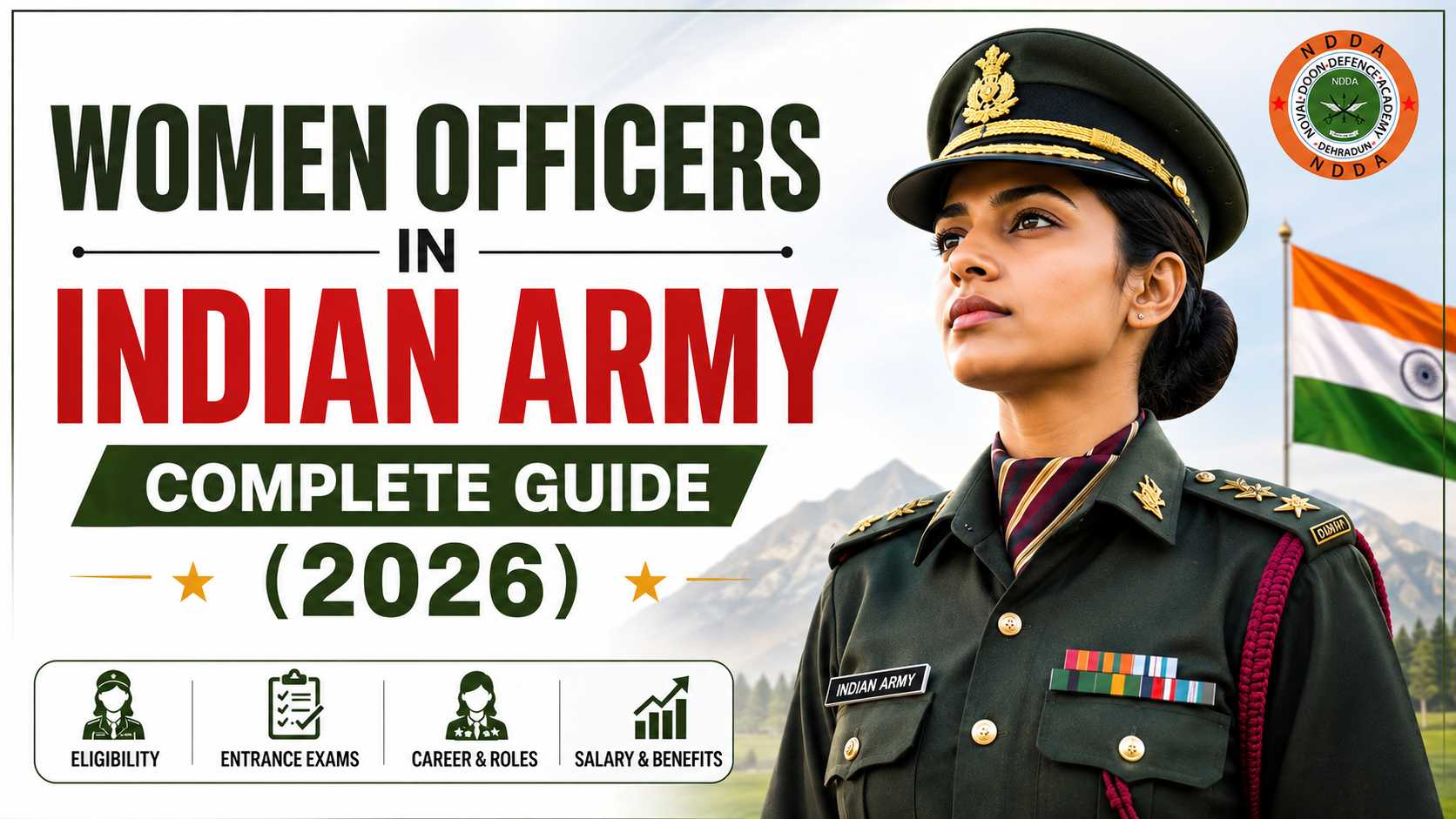
Table of Contents
For decades, the Indian Army was seen as a male bastion. That picture has changed for good. Today, Women Officers in Indian Army units lead convoys, fly reconnaissance missions, argue court-martial cases, and command troops at the Line of Control. From the historic first batch of lady cadets commissioned through the National Defence Academy (NDA) to the Supreme Court’s landmark Permanent Commission verdict, the journey of women in the Indian Army has been one of steady, hard-won progress.
How to become a woman army officer, in short: clear Class 12 or graduation depending on your chosen entry, sit for the relevant written exam (NDA, CDS, or SSC screening), clear the five-day SSB interview, pass the medical board, and complete training at NDA/OTA/IMA before being commissioned as a Lieutenant. The sections below walk through each of these entry schemes and stages in detail.
1. Who Are Women Officers in Indian Army?
Indian Army women officers are commissioned leaders — not soldiers recruited through the ranks, but graduates and cadets who clear a written exam or direct entry, pass the Services Selection Board (SSB), and complete rigorous training before being commissioned as Lieutenants. They serve across corps such as Army Air Defence, Army Service Corps, Corps of Engineers, Signals, Judge Advocate General (JAG), Army Education Corps (AEC), Army Medical Corps (AMC), and Military Nursing Service (MNS), among others.
According to the Chief of the Army Staff, the Army currently has around 1,732 women officers, with plans to raise this number to over 2,000 in the coming years as new avenues such as the Territorial Army open up for women. This reflects a broader push for gender-neutral recruitment policies across India’s defence forces, and a growing presence of women serving in Indian Army postings that were once closed to them.
2. A Brief Timeline of Women in the Indian Army
- 1888: Formation of the Indian Military Nursing Service — the earliest formal entry of women into the Army.
- 1992: Women commissioned as officers for the first time through the Short Service Commission (SSC) in non-combat branches.
- 2008: SSC tenure extended, giving women officers longer careers before release.
- 2020: The Supreme Court of India ruled that SSC women officers are entitled to Permanent Commission on par with male officers.
- 2021–22: The NDA entrance exam was opened to women for the first time, following a Supreme Court directive, allowing girls to join alongside men straight after Class 12.
- 2026: The Indian Military Academy, Dehradun commissioned its first-ever batch of NDA lady cadets — women who had entered through the NDA route and completed pre-commission training at IMA — a historic milestone for women officers.
This timeline shows how policy, judicial intervention, and institutional reform have together expanded opportunities for women in the Indian Army.
3. Entry Schemes for Women Officers in Indian Army
There are multiple official pathways for women who want to become commissioned Army officers. Each of these women Army officer entry schemes has its own eligibility, exam pattern, and training duration.
a) National Defence Academy (NDA) Entry Unmarried women who have passed Class 12 can now sit for the NDA written exam conducted by the UPSC, followed by SSB and training at NDA, Khadakwasla, and the respective service academy. NDA for women in Indian Army remains the earliest possible entry point, letting girls join straight out of school. The NDA exam pattern for girls is identical to that for male candidates — a written paper covering Mathematics and General Ability, followed by the SSB and medical stages.
b) Short Service Commission — Non-Technical (SSCW), via CDS Graduate women aged 19–25 years can apply through the CDS exam (conducted by the UPSC) for the SSC Non-Technical Course at the Officers Training Academy (OTA), Chennai. As of now, this women’s CDS route leads only to OTA, not IMA — the CDS exam for women Army officers commissions them into branches like AEC, JAG, Army Air Defence, and Intelligence Corps after 49 weeks of training.
c) Short Service Commission — Technical (SSCW Tech) Engineering graduate women aged 20–27 years can apply directly (no written exam) for technical branches such as Corps of Engineers, Signals, and EME, followed by SSB and training at OTA Chennai. This SSC Tech entry for women in Indian Army route skips the written exam stage entirely for eligible engineering graduates.
d) NCC Special Entry Scheme (Women) Women who hold an NCC ‘C’ Certificate from the Senior Wing/Division with a minimum ‘B’ grade can apply without any written exam. The NCC Special Entry for women is one of the fastest routes to becoming a woman officer.
e) Judge Advocate General (JAG) Entry Law graduates with an LL.B degree can apply for direct entry into the Army’s legal branch as a Permanent Commission officer. This JAG entry for women in Indian Army is a direct route straight to Permanent Commission status.
f) Army Education Corps (AEC) & Technical Graduate Course (TGC) Postgraduate women (for AEC) and engineering graduates (for TGC) can join through these specialised, direct-entry schemes.
g) Army Medical Corps (AMC) & Military Nursing Service (MNS) MBBS graduates can join the AMC, while nursing graduates can apply to the MNS — both long-standing routes for women in uniform.
Notifications for all these schemes are released periodically on the official Join Indian Army portal, and aspirants should always cross-check dates and vacancies there before applying.
A quick note on Agniveer: these are officer-entry schemes, commissioning candidates as Lieutenants. Women can also join the Army as an Agniveer under the Agnipath Scheme (for example, Agniveer General Duty in the Corps of Military Police) — but that is a separate, non-officer, four-year track with its own eligibility and selection process, distinct from the commissioned-officer routes covered in this guide.
4. Eligibility Criteria for Women Officers (2026)
While specifics vary by entry scheme, the broad eligibility framework for women officer aspirants includes:
- Nationality: Must be an Indian citizen.
- Marital Status: Unmarried (for most SSC and NDA entries); certain direct-entry schemes like AMC/JAG have relaxed conditions.
- Age: The age limit for women officers ranges from 19–27 years depending on the entry scheme.
- Education: Class 12 (NDA), graduation (SSC Non-Tech, JAG, AEC), or engineering/medical degree (SSC Tech, AMC), as applicable.
- Physical Standards: Minimum height and weight norms, and specific medical fitness standards laid down for women candidates, are assessed during the recruitment medical examination.
Aspirants should always verify the latest eligibility notification for the specific entry, since minor changes are announced from time to time.
5. Selection Process — Written Exam, SSB & Medical
The path to becoming a woman officer in the Indian Army follows the same rigorous three-stage process applicable to male candidates:
- Written Examination: Applicable for NDA, CDS, and SSC (Non-Technical) entries, conducted by UPSC or the Army’s recruiting directorate.
- Services Selection Board (SSB): A five-day assessment involving psychological tests (TAT, WAT, SRT), Group Testing Officer (GTO) tasks, and a personal interview to evaluate Officer Like Qualities (OLQs).
- Medical Examination: Conducted by a Board of Service Medical Officers to confirm fitness as per Army medical standards.
Candidates who clear all three stages are placed in the final merit list based on performance and available vacancies.
SSB interview tips for women candidates: the assessment criteria are the same for men and women, so preparation should focus on the same fundamentals — clear, confident communication in the personal interview; realistic, action-oriented responses in the TAT and WAT rather than rehearsed lines; visible teamwork and initiative during GTO outdoor tasks; and genuine, consistent answers across all five days, since assessors are trained to spot inconsistency between what a candidate says and how they act in group tasks.
6. Training Academies for Women Officers
Once selected, women officers undergo the same intensity of training as their male counterparts at premier institutions:
- National Defence Academy (NDA), Khadakwasla — for women entering through the NDA route, alongside male cadets.
- Officers Training Academy (OTA), Chennai — the primary training ground for SSC women officers across most branches.
- Indian Military Academy (IMA), Dehradun — where women cadets from NDA and CDS entries complete pre-commission training before being commissioned as Lieutenants.
- Armed Forces Medical College (AFMC), Pune — for AMC officers.
Training includes drill, weapon handling, tactics, physical endurance, and leadership modules, ensuring parity in standards between men and women officers. Women officer training at IMA follows the exact same curriculum, drill standards, and assessment benchmarks as the training given to male gentlemen cadets.
7. Branches and Corps Open to Women
Over the years, the list of branches open to Indian Army women officers has expanded significantly. Women currently serve in:
- Army Air Defence (AAD)
- Corps of Engineers
- Corps of Signals
- Army Service Corps (ASC)
- Army Ordnance Corps (AOC)
- Electrical & Mechanical Engineers (EME)
- Intelligence Corps
- Judge Advocate General (JAG) branch
- Army Education Corps (AEC)
- Army Medical Corps (AMC) and Military Nursing Service (MNS)
Combat arms such as Infantry, Armoured Corps, and Mechanised Infantry remain closed to women officers as of now, though policy discussions on expanding combat roles continue at the government level.
8. Permanent Commission for Women Officers
One of the biggest turning points for female army officers in India came with the Supreme Court’s 2020 ruling, which held that SSC women officers are entitled to Permanent Commission on the same terms as men — ending a 10–14-year cap on their careers. Following the judgment, the Ministry of Defence formally sanctioned Permanent Commission for eligible women officers, opening the door to command postings, promotions up to senior ranks, and pension benefits on par with male officers.
This shift means that a woman officer joining today through SSC is no longer limited to a short tenure — with the right performance record, she can serve a full career and rise through the ranks, similar to her male counterparts. Promotions follow the same women army officer rank structure used for male officers — Lieutenant, Captain, Major, Lieutenant Colonel, Colonel, and beyond — based on time-in-service and selection boards.
9. Women Officers Who Made History
The policy shifts above aren’t just paperwork — they’ve translated into real, visible firsts. A look at how far women officers in Indian Army service have come:
- Priya Jhingan became the Army’s first lady cadet, joining the Officers Training Academy, Chennai, as part of the pioneering 1992 batch that first opened non-medical corps to women — the starting point for everything that followed.
- Major Navya Shekhawat, an Army Service Corps officer who entered through the CDS exam and trained at OTA Chennai, became the first woman officer from the Indian Army to be appointed Aide-de-Camp (ADC) to the President of India, serving alongside President Droupadi Murmu at Rashtrapati Bhavan. She is only the second woman overall to hold this role across the three services, after the Navy’s Lieutenant Commander Yashasvi Solanki was appointed in 2025.
- Captain Shivani Sehrawat followed soon after, becoming the first woman officer appointed ADC to the Chief of the Army Staff in mid-2026 — one of the most trusted staff postings in the Army, working directly with the Army’s senior-most officer.
- Lieutenant General (Dr.) Punita Arora became the first woman in the Indian Armed Forces to reach three-star rank, rising through the Army Medical Corps to hold flag rank in both the Army and the Navy over a distinguished medical and administrative career.
- Lieutenant General (Dr.) Madhuri Kanitkar became the third woman to reach three-star rank, in 2020, and the first woman paediatrician to do so — going on to serve as Deputy Chief of Integrated Defence Staff (Medical).
- Colonel Sofiya Qureshi, of the Corps of Signals, became the first woman officer to lead an Indian Army contingent at a major multinational military exercise (Exercise Force 18, 2016), after earlier serving as a UN military observer in Congo. She later gained national recognition for briefing the media on a major military operation in 2025.
Together, these milestones show a clear pattern: once permanent commission and command eligibility opened up, women officers moved quickly into command, staff, and flag-rank roles that were previously closed to them — a trend aspirants can expect to continue as more women join through NDA, CDS, and the other entry schemes covered in this guide.
How NDDA Prepares Girls for a Defence Career
At Noval Doon Defence Academy (NDDA), we have trained and guided hundreds of girl aspirants toward becoming future women officers in Indian Army, Navy, and Air Force. Our girls’ batches receive the same rigorous academic coaching, daily physical training, and SSB-focused personality development as our regular courses — delivered by ex-defence officers, including former SSB assessors.
If you are preparing for the NDA exam after Class 12, our NDA coaching in Dehradun covers the complete written syllabus and SSB preparation for both male and female aspirants. Students in Class 8th–12th can start early with our NDA Foundation coaching in Dehradun, which builds the academic and physical base years in advance — widely regarded as the Best NDA Coaching in Dehradun for early starters, and among the go-to choices for the best defence academy for girls in Dehradun. Girls specifically preparing for the NDA and other women’s entry schemes can also read more about our dedicated NDA coaching for girls in Dehradun.
FAQs
Yes. Following a Supreme Court directive, women have been eligible to appear for the NDA written exam since 2021, allowing them to join right after Class 12 alongside male cadets.
It varies by entry — NDA aspirants can apply from around 16.5–19.5 years, while graduate-entry schemes like SSC (Non-Technical) accept candidates aged 19–25 years.
Yes. Since the Supreme Court’s 2020 verdict and the subsequent government order, SSC women officers are eligible for Permanent Commission in the same branches as men, subject to performance and vacancies.
Combat arms such as Infantry, Armoured Corps, and Mechanised Infantry are presently not open to women officers, though this is a subject of ongoing policy review.
All official notifications are released on the Join Indian Army portal and, for UPSC-conducted exams like NDA and CDS, on the UPSC website.
Reach Us