
10 PPDT Pictures for SSB Interview: Complete Guide with Sample Stories (2026)
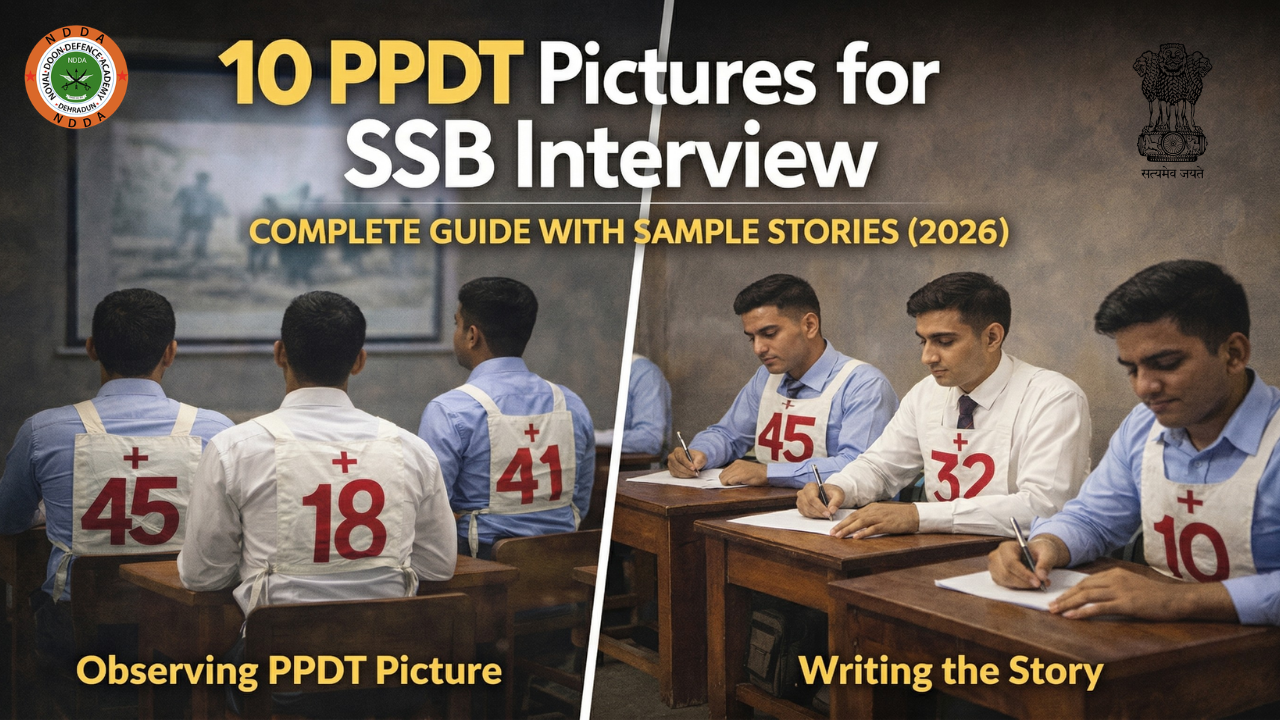
Table of Contents
As the leading NDA and SSB coaching institute in Dehradun, Noval Doon Defence Academy has witnessed thousands of candidates face this exact, nerve-wracking challenge. We see brilliant, physically fit, and academically gifted aspirants get screened out on the very first day simply because they lack the right strategic approach. They write exaggerated Hollywood scripts instead of realistic, action-oriented narratives, or they fail to communicate effectively during the subsequent group discussion.
This is the defining reality of the Picture Perception and Description Test. Mastering PPDT Pictures for SSB Interview is not just about having a good imagination; it is about projecting the exact Officer Like Qualities (OLQs) that military assessors are desperately hunting for on Day 1.
Understanding the Ultimate Gatekeeper
Before you start downloading massive folders of practice sets, you must deeply understand the mechanics of the test. What exactly is going on in the psychologist’s mind when they evaluate your sheet? The board utilizes PPDT Pictures for SSB Interview because ambiguous images force your subconscious mind to reveal its true nature.
Phase 1: Picture Perception and Story Writing
When you sit down to practice with PPDT Practice Images for SSB, you need to simulate the exact, high-pressure timeline used by the selection board:
- The 30-Second Observation Window: A hazy, intentionally ambiguous photograph is shown on the screen. Why is it hazy? Because clear images leave no room for imagination. The blurriness forces your brain to project its own internal state, biases, and problem-solving mechanisms onto the characters. You must rapidly absorb the background environment, the total number of characters, and the general atmosphere of the scene.
- The 1-Minute Detail Box: Immediately after the image disappears, you get one minute to fill out a printed square box on your sheet. You must mark the spatial position of the characters and identify their Age, Gender (Male, Female, Person), and Mood (Positive, Negative, Neutral). You are also required to circle your main character, commonly referred to as the “hero.”
- The 4-Minute Writing Phase: You must now write a complete, realistic short story. A winning story structure always has three distinct pillars:
- The Background: What logical events led to the current situation shown in the picture?
- The Present Action: What is currently happening, and what specific steps is your hero taking to manage the situation?
- The Logical Outcome: What is the positive, realistic future result of the hero’s actions?
The Core Objectives of the Assessors
Why does the Indian Armed Forces rely so heavily on this specific psychological screening? Because your response to unexpected ambiguity strips away memorized coaching answers and reveals your true character. When evaluating your PPDT Pictures for SSB Interview sheets and observing your group behavior, the assessors are hunting for specific traits:
- Reasoning Ability and Organizing Competence: Can you look at a chaotic, stressful scene and immediately formulate a structured, step-by-step plan of action? Do you utilize the resources available in your environment wisely?
- Social Adaptability and Empathy: Do your narratives feature a protagonist who helps society, works seamlessly with others, and understands their civic duties? The military is built on camaraderie; lone wolves are not preferred.
- Initiative and Courage: When faced with an accident or a crisis in the picture, does your hero simply call the police and wait as a passive bystander, or do they take immediate, practical, hands-on steps to mitigate the disaster?
- Power of Expression: Can you articulate your thoughts clearly, concisely, and confidently without fumbling, using excessive jargon, or demonstrating aggressive body language?
Winning Strategies for Stage 1
Before we dive into the specific sample stories, lock these golden rules into your brain. These are the foundational strategies we drill into our recommended students at Noval Doon Defence Academy when they analyze PPDT Pictures for SSB Interview.
- Keep it Hyper-Realistic: Life is not a cinematic blockbuster. Do not write about sudden alien invasions, extreme international terrorist attacks (unless the image explicitly shows combat gear), or Bollywood-style physics-defying heroics. If you see two normal people talking on a street, they are likely just planning a college festival or resolving a minor civic issue, not planning a sophisticated bank heist.
- Mirror Yourself in the Hero: The hero of the story is your psychological avatar. Make your main character roughly your own age and gender. If you are a 21-year-old engineering student, make your hero a young adult with a technical or academic background. This makes your story authentic and believable.
- The Action is Everything: Assessors do not care about flowery, poetic language or complex vocabulary. They care entirely about what your hero did. Focus 70% of your word count on the “Action” part of the story. Use the foolproof formula: Identify the core problem → Gather resources or a team → Execute a logical plan → Achieve a positive, measurable result.
Common Myths vs. Reality in Story Writing
Many candidates ruin their chances by falling for prevalent online myths regarding the screening test. Let us clear the air:
- Myth: You need perfect, flawless English grammar to get recommended.
- Reality: You need clarity of thought. While basic grammar is necessary for communication, assessors are looking at your ideas, logic, and actions. A highly logical story written in simple, slightly broken English will always beat a grammatically perfect story that lacks practical sense.
- Myth: You must completely avoid negative themes like death, accidents, or sadness.
- Reality: You must avoid unresolved negativity. If a picture clearly shows an accident, denying it and writing a happy party story shows a lack of practical perception. Acknowledge the negative situation (the accident), but focus the story on the positive, active resolution (the rescue and medical aid).
10 PPDT Pictures for SSB Interview with Sample Stories (2026 Edition)
Below are ten highly realistic scenarios covering various themes you will face. Remember to use your own original thought process during the actual exam. These serve as a benchmark for high-quality preparation and demonstrate how to handle different types of PPDT Pictures for SSB Interview.
Picture 1: Simplifying Government Schemes for the Rural Community
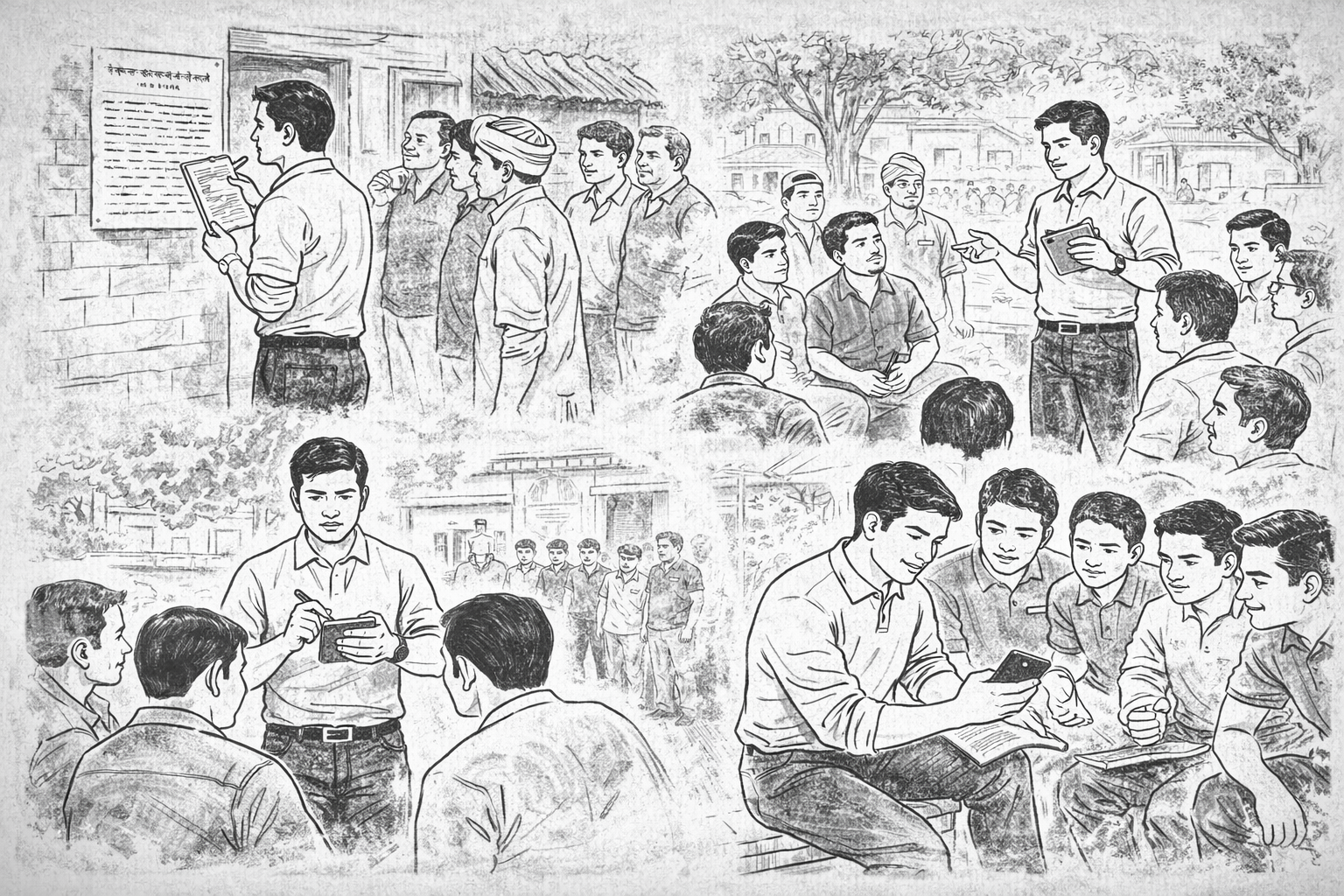
- The Observation: A group of people, mostly appearing rural or semi-urban, looking slightly confused or deep in thought near a public notice board.
- The Story: Rohan, a 23-year-old postgraduate student, was visiting his native village for the Diwali holidays. While walking past the local Panchayat office, he noticed a group of local farmers and youth looking confused at a newly pasted notice regarding a government skill-development and farming subsidy scheme. Realizing the official language was too technical for them to grasp, Rohan immediately stepped in. He read the document thoroughly, took out his notebook, and broke down the complex eligibility criteria and application steps into simple, local dialect bullet points. He held a brief 15-minute awareness session right there, explaining how the youth could get free vocational training. Furthermore, he used his smartphone to help five young men register on the government portal immediately before the evening deadline. The villagers thanked him for his timely, practical guidance.
- Assessor’s Analysis: This is a classic example of handling PPDT Pictures for SSB Interview where no physical life-or-death crisis exists, but a social one does. The hero shows incredible initiative, high social intelligence, and uses his higher education to practically uplift his community without seeking a reward.
Picture 2: Digital Empowerment for Local Artisans

- The Observation: A younger person standing in front of a small group of women in a rural or community hall setting, appearing to give a presentation or explanation.
- The Story: Vikram, a 24-year-old IT professional working in Pune, noticed that the local women in his hometown who crafted beautiful traditional bamboo products were earning very little by selling only to local middlemen. They had zero knowledge of wider markets. Vikram decided to empower them through structured digital literacy. He requested the local school headmaster to let him use a classroom on Sunday mornings. He gathered 15 female artisans and conducted a practical, hands-on workshop on how to use rural e-commerce applications on their basic smartphones. He taught them how to click well-lit pictures of their crafts, write simple descriptions, and set up a secure joint digital bank account. Within a month, the women formed a registered cooperative, received their first online bulk order from a city retailer, and significantly increased their profit margins.
- Assessor’s Analysis: Using PPDT Practice Images for SSB to showcase economic empowerment is highly favored by the board. It highlights the crucial Officer Like Qualities of organizing ability, empathy, and long-term visionary planning.
Picture 3: Fixing the Village Infrastructure

- The Observation: A landscape showing a dilapidated bridge, a blocked road, or a physically damaged community structure.
- The Story: Ajay, a 22-year-old civil engineering student, was on a trekking expedition with his college adventure club in the hills of Uttarakhand. Along the route, he noticed that the primary wooden suspension bridge connecting a remote village to the main highway had severely loose support cables and rotting wooden planks, posing a massive daily risk to school children. Ajay immediately halted his trek and met the village head. He drafted a quick, logical safety assessment using his engineering background. He motivated his fellow trekkers and the local village youth to form a joint, voluntary task force. While the village head provided new treated timber and thick steel ropes from the Panchayat funds, Ajay directed the team to safely replace the broken planks and properly anchor the support cables. They finished the repair by evening, ensuring safe passage for everyone before continuing their journey.
- Assessor’s Analysis: This narrative is perfect for mastering PPDT Pictures for SSB Interview because it effortlessly demonstrates practical knowledge application, physical stamina, and dynamic team leadership in a rugged environment.
Picture 4: The Convocation Preparation

- The Observation: A solitary figure standing, seemingly deep in thought, looking at a reflection, or preparing for an event.
- The Story: Sneha, a 22-year-old recent engineering graduate, stood before the mirror in her college hostel room, carefully adjusting her formal attire. She had been chosen as the batch valedictorian to deliver the farewell and convocation speech later that afternoon. She wasn’t just checking her physical appearance; she was doing a final, rigorous mental run-through of her speech. Over the past week, Sneha had proactively spoken to various department heads, junior students, and classmates to ensure her speech captured the collective memories, struggles, and future aspirations of her entire batch. She took a deep breath, practiced her voice modulation and posture in the mirror to project maximum confidence, and organized her index cue cards. She delivered an inspiring, flawless speech that afternoon, receiving a standing ovation from the faculty and proud parents.
- Assessor’s Analysis: Single-character images often confuse candidates, making them write depressive or lonely stories. This narrative brilliantly pivots isolation into productive preparation, self-confidence, and taking responsibility for representing a group.
Picture 5: Modern Agriculture Integration

- The Observation: Two or more people interacting in a rural field, farm, or agricultural background.
- The Story: Karan was a young, enthusiastic agricultural science graduate. During the crucial sowing season, he observed that his neighbor, an elderly traditional farmer named Ramu, was suffering from consistently low crop yields due to outdated farming techniques and severely depleted soil health. Karan decided to intervene constructively rather than just watching. He approached Ramu respectfully and explained the modern benefits of crop rotation and soil testing. Karan personally collected soil samples from Ramu’s field and took them to the district agricultural laboratory. Upon receiving the scientific report, he guided Ramu on the exact ratio of organic fertilizers required to balance the pH levels. Furthermore, Karan helped him install a local weather-forecast and market-price app on his phone to optimize watering schedules. By the time of the harvest, Ramu’s crop yield had increased by 30%, and he became a vocal advocate for modern farming in the entire village.
- Assessor’s Analysis: This specifically demonstrates a deep awareness of real-world Indian contexts. It showcases a hero who provides sustainable, scientifically backed, long-term solutions rather than temporary emotional fixes when practicing with PPDT Pictures for SSB Interview.
Picture 6: The Immediate Medical Rescue
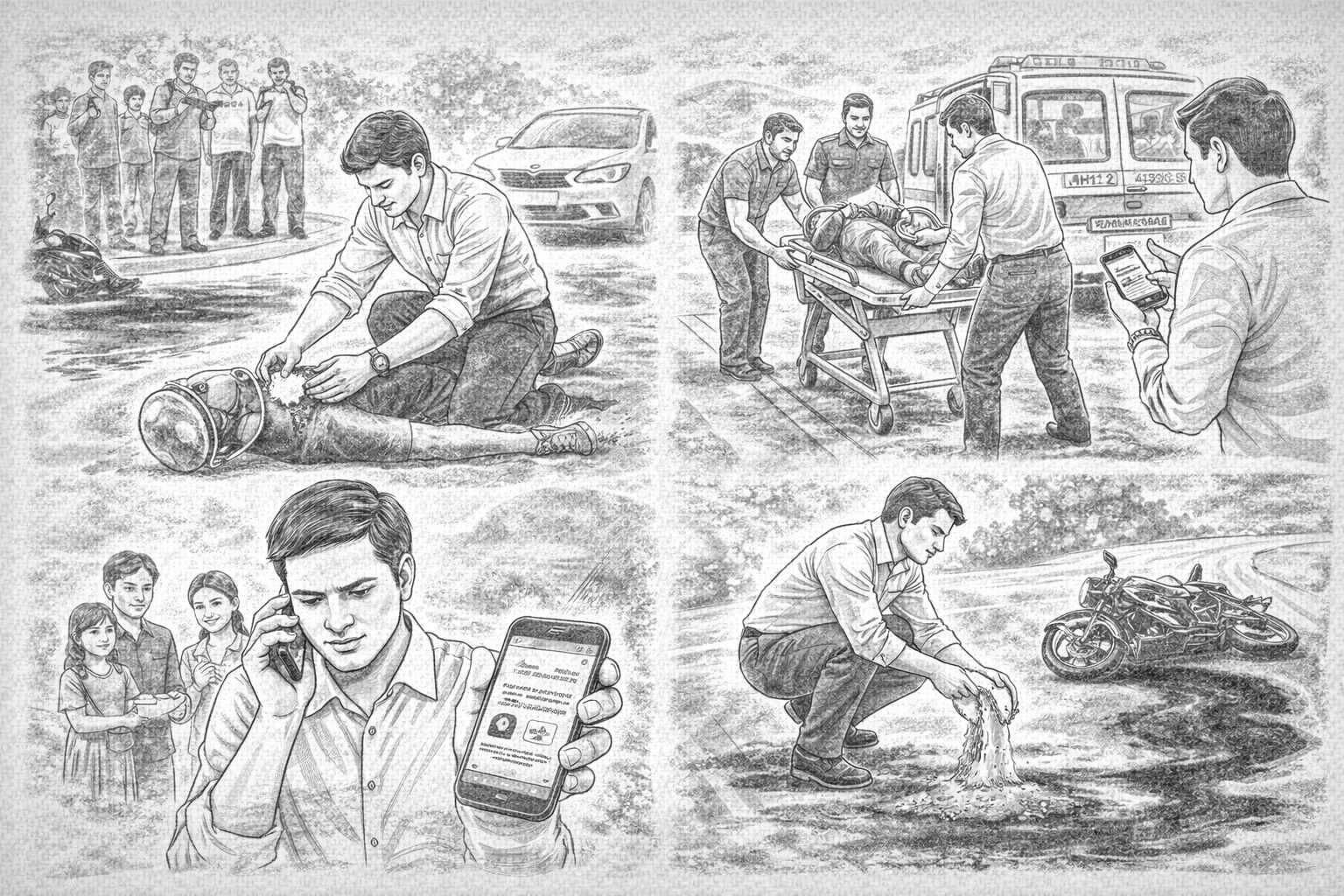
- The Observation: A chaotic scene depicting a road accident, someone injured on the ground, or a street commotion.
- The Story: Ankit, a 25-year-old bank manager, was commuting home from work when he witnessed a motorcyclist violently skid on a patch of leaked oil and crash heavily onto the pavement. The rider was conscious but bleeding profusely from a deep cut on his leg. While bystanders panicked and simply recorded videos, Ankit immediately took control of the situation. He parked his car safely to block oncoming traffic from hitting the injured man. He explicitly commanded a bystander to call the emergency ambulance service while he used his clean cotton handkerchief to apply firm pressure to the rider’s wound to arrest the bleeding. When the ambulance arrived, he helped properly load the patient, noted down the ambulance registration number, and used the rider’s phone to inform his family gently without causing them undue panic. He then stayed back to clear the oil patch with some dry sand from the roadside to prevent any further accidents.
- Assessor’s Analysis: In medical emergencies, the hero must prioritize life-saving first aid and traffic management over fighting with the culprit or arguing. This story hits every practical safety protocol perfectly.
Picture 7: Civic Responsibility at the Lake

- The Observation: A casual group of people near a lake, river, or tourist location, seemingly relaxing.
- The Story: Rahul and his college friends went for a much-needed weekend camping trip to a popular, scenic lake outside the city limits. Upon arriving, Rahul noticed that the beautiful shoreline was heavily littered with plastic waste left by previous careless tourists, and there were absolutely no warning signs about the sudden, dangerous deep drop-offs in the water. Not wanting to ruin the local environment further, Rahul organized his friends into a highly efficient, quick cleanup crew. They spent the first hour diligently collecting all the plastic bottles and wrappers into large garbage bags they had brought along. Furthermore, Rahul spoke to a local boatman and borrowed some discarded wooden stakes and bright red cloth. He created makeshift warning flags and clearly marked the safe swimming zones for other families visiting the area. They then enjoyed a clean, safe, and highly fulfilling camping trip.
- Assessor’s Analysis: This is one of the strongest ways to handle PPDT Pictures for SSB Interview because it takes a leisurely, casual activity and injects a profound sense of civic duty, environmental responsibility, and safety consciousness.
Picture 8: Securing the Elderly Online

- The Observation: Two people of different generations interacting, looking concerned or focused on a book, document, or device.
- The Story: Siddharth, a 22-year-old software engineering student, noticed his grandfather and his elderly friends looking visibly worried while discussing recent newspaper reports about rampant online banking frauds. They were terrified to pay their utility bills online, preferring to stand in exhausting, long queues at the bank despite their physical joint ailments. Siddharth decided to permanently solve this anxiety. He invited his grandfather’s friends over for evening tea and connected his laptop to the large living room TV. He conducted a simple, jargon-free, step-by-step tutorial on how to use secure banking applications. He taught them how to verify official UPI IDs, the critical importance of never sharing OTPs over a call, and how to create strong, memorable passwords. He patiently helped them pay their electricity bills that day. The elderly group felt confident, safe, and technologically empowered.
- Assessor’s Analysis: It addresses a highly modern, relevant issue. The hero displays immense patience, deep respect for elders, and effective communication skills—all vital traits for an officer.
Picture 9: The Athletic Rescue

- The Observation: A scene of intense physical action, someone running fast, scaling a wall, or dealing with a fire in a building.
- The Story: Tarun, a university-level decathlon athlete, was jogging his early morning route when he heard a frantic, muffled cry from a two-story residential house. He looked up to see thick, black smoke billowing from a first-floor window and realized a young teenager was trapped inside, completely unable to open the jammed wooden door due to the intense heat expansion. With the fire brigade still on the way, Tarun knew waiting meant certain tragedy; he had to act fast. Rapidly assessing the structural integrity, Tarun used his athletic agility to scale the sturdy iron drainage pipe beside the window. He carefully broke the glass pane with his elbow tightly wrapped in his thick track jacket. He pulled himself in, kept extremely low to avoid the toxic smoke inhalation, and guided the terrified teenager to the window. Using a heavy, soaked bedsheet as a makeshift safety harness, he safely lowered the teenager to the anxious neighbors gathered below before swiftly climbing down himself.
- Assessor’s Analysis: This is a highly dynamic entry when evaluating PPDT Pictures for SSB Interview. It beautifully showcases calculated physical courage, rapid risk assessment, and decisive action under severe, life-threatening stress.
Picture 10: Managing the Chaos

- The Observation: A large crowd looking agitated, panicked, or moving rapidly in a public commercial space.
- The Story: Deepak, a 25-year-old logistics executive, was shopping at the crowded local market when a sudden small fire broke out in the main electrical panel of a nearby wholesale cloth shop. The shopkeepers panicked immediately, and the dense crowd started rushing haphazardly, rapidly creating a dangerous stampede-like situation. Deepak immediately stepped onto a raised concrete platform to gain maximum visibility. Using a loud, authoritative, yet calming voice, he instructed the crowd to stop pushing and move towards the two main designated market exits systematically. He instructed two other capable youths to form a human chain to guide the elderly and children safely out of the bottleneck. Meanwhile, he directed the specific shop owner to use the ABC fire extinguisher kept in the adjacent store to tackle the electrical fire from a safe distance, ensuring the main power switch was aggressively turned off first. His quick, organized crowd management prevented injuries and contained the fire before emergency services arrived.
- Assessor’s Analysis: True military leadership is about managing chaos effectively. The hero does not foolishly try to fight the fire alone with his bare hands; he delegates tasks, controls the panicked crowd, and uses available resources efficiently.
Mastering the Group Discussion (GD) Phase
Writing a phenomenal story is only 50% of the battle. The Group Discussion is where the actual screening happens. When 15 highly stressed candidates try to prove their worth simultaneously, it naturally turns into a chaotic “fish market.”
How to dominate the GD:
- The Narration: When it is your turn to narrate, sit up completely straight, put your hands on your lap, and look directly into the eyes of your fellow candidates—not the assessors. Speak with a loud, clear, and unwavering voice. Do not memorize your story word-for-word; narrate the core action smoothly.
- Entering the Chaos: When the GD starts and everyone begins shouting, do not try to out-shout them. Wait for that inevitable split-second pause when people run out of breath. Enter firmly: “Gentlemen, if I may add a constructive point…”
- Be the Consolidator: The assessors love candidates who bring the group together. If two people are arguing about the age of the hero, step in: “Friends, since most of us perceived the hero as a young adult, let us agree the age is around 24 and move forward to discussing the action plan to save time.”
How Noval Doon Defence Academy Prepares You
Reading theory about PPDT Pictures for SSB Interview is an excellent starting point, but Stage 1 is a brutal test of real-time execution under extreme pressure. At Noval Doon Defence Academy in Dehradun, we bridge the massive gap between reading a blog and actually performing in the testing hall.
When you enroll in our specialized NDA and SSB training batches, you do not just get a static workbook. You experience the exact, high-stakes testing environment daily.
- Simulated Daily Screenings: We project original, highly ambiguous hazy images under strict, unforgiving time limits to train your brain’s reflexes to automatically default to positivity and logical action.
- Intensive Mock Group Discussions: Our simulated GD rooms are strictly monitored by veteran ex-SSB assessors who provide brutal, honest, and highly constructive feedback on your body language, vocal tone, and ability to influence a group.
- Cognitive Rewiring: We help you identify your own unique strengths and map them directly to the 15 Officer Like Qualities, ensuring your stories are authentically yours and not just cloned from a generic textbook.
People Also Ask (FAQs)
1.What is the full form of PPDT pictures for SSB?
The full form is the Picture Perception and Description Test. It serves as the primary psychological and behavioral screening tool utilized on Day 1 of the Service Selection Board (SSB) interviews to weed out candidates who lack basic officer-like traits.
2.What are PPDT pictures used for exactly?
These intentionally ambiguous images act as a psychological mirror. Because the picture is blurry and unclear, your brain is forced to fill in the missing gaps using your own subconscious thoughts, daily habits, and problem-solving mechanisms. The military assessors use this to scientifically check if you possess a positive, constructive, and action-oriented mindset.
3.How to crack the PPDT test in SSB on the first attempt?
Cracking the test consistently requires a disciplined three-pronged approach:
- Accurately perceive the basic facts (number of characters, background).
- Write a highly realistic, action-heavy story with a clear problem and a logical, positive outcome without relying on miracles.
- Participate in the Group Discussion constructively—listen actively, do not shout aggressively, and actively help the group reach a logical consensus.
4.What specific items should I carry for an SSB interview?
For the actual testing hall, carry multiple reliable blue/black ballpoint pens, as you will be writing very fast and pens often fail. Beyond that, bring your official call letter, all original educational certificates, valid government ID proof, neat formal attire for the personal interview, and standard white PT shoes with sports clothing for the rigorous GTO outdoor tasks.
Conclusion
Conquering the PPDT Pictures for SSB Interview is your golden ticket to unlocking the rest of the grueling but rewarding SSB testing battery. It is a profound test of character just as much as it is a test of observation and imagination. By practicing daily with the right positive mindset, focusing heavily on logical, step-by-step actions, and projecting a confident, cooperative demeanor during the high-stress group discussion, you can comfortably clear Stage 1 and move closer to your dream.
Do not let a blurry image on a screen blur your lifelong dreams of donning the prestigious military uniform. The Armed Forces are looking for leaders, not writers. Show them your leadership on paper and in the discussion room.
Reach Us